Philadelphia in the National Spotlight:
PHILADELPHIA’S PROGRESS — AND THE COLLABORATION BEHIND IT — TAKES CENTER STAGE AT THE TRACE FORUM
The Civic Coalition to Save Lives and Comcast served as presenting sponsors of Safer Together: A Forum on Gun Violence Solutions, hosted November 18 by The Trace at WHYY Studios. The gathering brought national experts, researchers, practitioners, survivors, journalists, and policymakers together to examine what’s working in gun violence intervention – and what it will take to sustain Philadelphia’s historic progress.

Philadelphia’s selection as the host city was no coincidence. The city recently recorded its lowest homicide rate in more than 50 years and achieved the most significant per-capita gun-violence reduction of any major U.S. city last year. As The Trace noted, the forum aimed to go beyond reporting those declines and instead explore the coordinated strategy, community partnership, and shared responsibility that made them possible.
SETTING THE TONE: DAVID BROWN AND ADAM GEER ON COLLABORATION AND COORDINATION
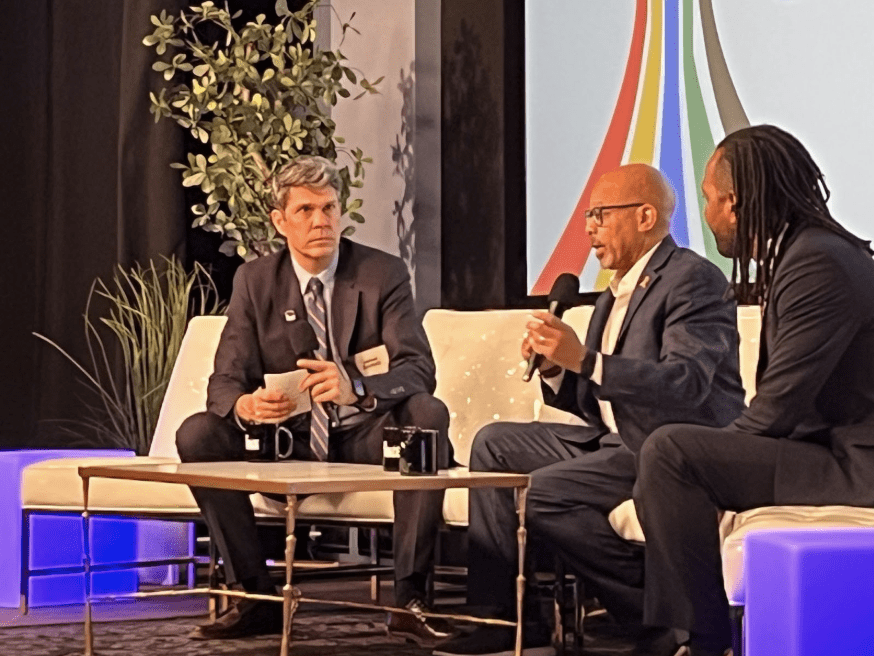
The forum opened with a conversation between Civic Coalition to Save Lives Executive Director David Brown and Philadelphia’s Chief Public Safety Director Adam Geer, moderated by The Trace’s James Burnett.
Brown emphasized that Philadelphia’s recent progress stems from something simple but powerful: a commitment to working together across systems, a shift that began only in the past several years as the Office of Public Safety and the civic coalition both came into being.
What feels different is the fact that we’re working together… there’s a recognition that no one organization can do it. — David Brown
Geer echoed the point, calling today’s level of coordination across city agencies, community groups, and law enforcement “unprecedented.”
We’re building connective tissue – nerves throughout the city – linking government and community organizations. That coordination is new, and it’s essential. — Adam Geer

Both leaders underscored that collaboration isn’t abstract – it shows up in practical ways. Brown described how the Coalition’s ability to move resources quickly fills gaps the city can’t fill on its own, helping get tools and support onto the street faster. Geer pointed to that flexibility as directly connected to saving lives.
Brown also highlighted another ingredient behind the city’s recent gains: discipline and humility.
Knowledge is power, and knowing what you don’t know is wisdom. —David Brown
That posture – learning first, acting second – grounds the Coalition’s role as a civic backbone, supporting the ecosystem rather than directing it.
Bret Perkins on Civic & Corporate Responsibility
Speaking at The Trace’s National Forum on Gun Violence, Comcast executive and Coalition board member Bret Perkins opened with a story that brought the room instantly into focus. It started with a phone call. One night in 2020, as he walked home from dinner, his wife told him not to move – a shooting had erupted just blocks from their house. The next morning, standing on a basketball court covered in chalk circles marking 55 shell casings, he realized he didn’t understand what was happening in his own city – or what he could do about it. That moment became the beginning of his path into Philadelphia’s gun violence intervention work.
When we focus, when we work together with discipline, we can save lives. — Bret Perkins
Perkins spoke to the dual role that civic and corporate partners can play in supporting intervention work. Reflecting on his experience confronting gun violence in his neighborhood, he connected personal urgency with organizational responsibility.
Perkins emphasized that complex problems require cross-sector commitment, describing the early days of the Coalition as “sleeves rolled up, no titles, no excuses.” He underscored that the work succeeds when strategy is clear, data is used well, and partners stay aligned.
A Statewide Perspective from Lt. Gov. Austin Davis
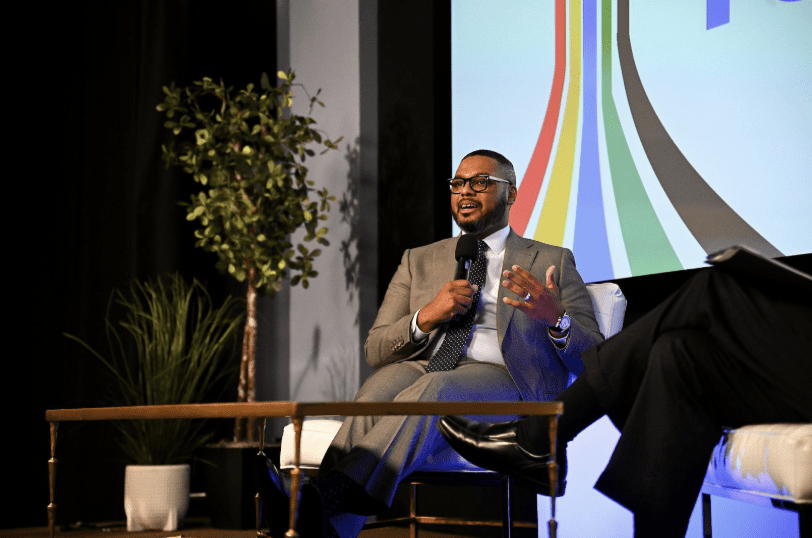
As the keynote speaker, Pennsylvania Lt. Gov. Austin Davis brought both the State perspective and a deeply personal understanding of the stakes. He spoke candidly about growing up in communities where violence was not an abstraction but a daily fear, and how those early experiences shape his priorities in office. He emphasized that Pennsylvania’s role is not simply to fund programs, but to support the local expertise already driving results, especially in places like Philadelphia where collaboration between the City, frontline practitioners, and civic partners is showing promising outcomes.
Davis noted the Commonwealth’s investments in intervention, behavioral health, and community-based organizations, but he also underscored that money alone is insufficient.
The best way to take a gun out of someone’s hand is to put a paycheck in it. We need to give young people multiple pathways – whether it’s college, apprenticeships, or starting a small business. We have to create real opportunities for success.
— Austin Davis, Pennsylvania Lt. Governor
Davis noted, “We have to build systems that last,” – systems that are rooted in evidence, informed by data, and sustained beyond election cycles. He highlighted Philadelphia’s coordinated approach as a model that the State is watching closely, and one that reinforces the importance of aligning policy, research, and community leadership.
Experts, Practitioners, and Survivors: What’s Working and What’s at Risk
Panels throughout the day brought together researchers from Temple and the Penn Crime Lab, credible messengers, hospital-based teams, environmental-design partners, and youth counselors – reflecting the full ecosystem behind Philadelphia’s recent progress.
Experts pointed to the drivers of the city’s declines:
- Focused intervention with those at highest risk
- Consistent credible-messenger engagement
- Coordinated case response
- Rapid data-informed adjustments
- Environmental improvements that make blocks measurably safer.
Practitioners described how these strategies play out daily across more than 170 organizations working in prevention, intervention, reentry, youth support, and trauma services.
Survivors and frontline workers emphasized that while the gains are real, they remain fragile. Protecting this progress will require continued investment, strong coordination, and disciplined strategy—the same alignment that helped produce Philadelphia’s historic reductions in the first place.
Looking Ahead
The Trace forum highlighted the work of the practitioners, community leaders, researchers, and public officials driving Philadelphia’s progress — and the shared commitment needed to keep moving forward. The Civic Coalition to Save Lives will continue serving as a learner, partner, and connector, helping strengthen the intervention ecosystem so those on the front lines have the resources, coordination, and stability they need to save lives.
GVICC TEAM GAINS NATIONAL INSIGHTS AT CITIES UNITED CONFERENCE

Each year, the Cities United Annual Convening brings together more than a thousand leaders from across the country who are working to reduce violence and strengthen community safety. The gathering has become one of the most important national spaces for cities advancing community violence intervention (CVI) – a place where policymakers, frontline practitioners, credible messengers, researchers, and survivors come together to learn from one another, share challenges, and refine their strategies.
For Philadelphia, this year’s convening at the end of October came at a pivotal time. The city has seen significant progress in reducing gun violence, and the Gun Violence Intervention Coordination Center (GVICC) – created by the Civic Coalition to Save Lives – is helping shape the next phase of that progress. Attending the 12th Annual Conference in Louisville gave GVICC staff the opportunity to see how other cities are building their intervention ecosystems, compare approaches, and bring home new ideas to strengthen Philadelphia’s work.
Conference Key Insight: “Philadelphia is aligned with national best practice”
It was within this broader national context that the experience resonated so strongly for Sara Autori, program director at GVICC. For her, the conference offered something rare in the field of community violence intervention: a space where people at every level – directors, credible messengers, survivors, youth, and long-time practitioners – could learn from one another as peers. As she described it, Cities United is “a unique opportunity for so many different levels to connect” and for people to share “their wins, their losses, and just human connection.”
Conference Key Insight: “Once you learn something, you become responsible for what you know the moment you know it.”
The atmosphere made an immediate impression. “There’s a feeling when you’re walking into the hotel and the event space – a joy,” she said. “That joy is really important when we’re doing this work.” The gathering brought together national leaders in ways that felt accessible and collaborative, creating a sense of collective momentum across the field.
Attending Cities United was a chance for the GVICC team to benchmark their work against national innovation. The GVICC supports core gun violence intervention programs such as Group Violence Intervention (GVI), Community Crisis Intervention Program (CCIP), and Pushing Progress Philly (P3), and helps strengthen the citywide ecosystem around housing, workforce development, and case coordination. The convening gave staff the opportunity to see how other cities are building similar systems – and how Philadelphia’s progress fits into that national picture.
Conference Key Insight: “Public safety has no voice without survivors.”
The timing also mattered. “It’s been an amazing year for a lot of cities in terms of violence reduction,” Autori noted. “Coming from Philadelphia, knowing we’ve made a big dent in violence, it didn’t feel like we were going there to say, ‘We figured it out.’ It felt like we were going there to say, ‘Okay, how do we push further?’”
The gathering also deepened insights around survivor-led organizations and the emotional and relational dimensions of intervention. As Sara noted, Cities United underscored that survivors help “take their pain and work with it to create power.”
Jacquelyn George, who leads GVICC’s data strategy, was particularly struck by the theme: “Public safety has no voice without survivors.” She also appreciated the conference’s focus on poly-victimization – the recognition that many who cause harm have also been harmed.
“They were looking at the full lens,” she said. “And it reminded me that frontline workers must stay at the center of strategy, and that we have to be trauma-informed for both the people we serve and the people doing the work.”
For Terrell Roberts, who leads GVICC’s workforce and economic-mobility strategy, the greatest value was the chance to build connections.
“The biggest value was the networking – building real relationships I can now reach back out to,” he said. He was also encouraged to hear cities across the country reporting progress: “You heard it everywhere – gun violence is going down. That was powerful.”
Conference Key Insight: “We all have the need to feel known — and credible messengers meet that need.”
One session in particular brought Autori new insight: a discussion on survivor-led organizations. She explained that these groups differ from traditional victim services agencies by offering support not only in the immediate aftermath of a shooting, but again months later, when families are better able to articulate what they need. She noted a panelist’s assertion that survivor-led organizations work with victims to “take their pain and work with it to create power.”
Other insights stayed with her as well, including one that captured the heart of credible messenger work: “Young men don’t need more discipline. They need love.”
Across the convening, the GVICC team saw clearly how Philadelphia’s coordinated approach aligns with national best practices — and how much opportunity exists to push further. As Autori reflected, “We weren’t going there to say, ‘We figured it out.’ We were going to ask, ‘How do we keep going?’”
PHILADELPHIA POLICE SEEK INPUT ON NEW STRATEGIC PLAN
The Civic Coalition to Save Lives is partnering with Philadelphia Police to engage residents in shaping the city’s five-year public safety plan.
The Philadelphia Police Department is inviting residents to help shape its new five-year strategic plan.
Residents can visit the department’s strategic plan website to learn more and take the online survey.

The Civic Coalition to Save Lives is proud to partner with the Philadelphia Police Department on this effort to ensure that the city’s public safety strategy reflects both evidence-based best practices and the lived experiences of residents. By strengthening collaboration between law enforcement, community leaders, and civic partners, the Coalition continues its mission to reduce gun violence and build safer, healthier neighborhoods across Philadelphia.
ICYMI
News Roundup: Spotlight on Intervention
Each month, we feature news stories from Philadelphia and beyond that highlight the power of intervention—showcasing programs, research, and community efforts working to prevent violence, support those at highest risk, and build safer neighborhoods through proven, people-centered strategies

These five cities help explain why homicide rates are down across the U.S. By Reis Thebault, Katie Mettler, Tim Craig, Kim Bellware, Ben Brasch, John D. Harden and Carson TerBush | November 20, 2025
A comprehensive analysis of 52 major U.S. cities by the The Washington Post reveals nearly a 20% drop in homicides between 2021 and 2024. The cities highlighted, Philadelphia, Baltimore, Chicago, Indianapolis and Los Angeles, underscore that sustained declines stem from a mix of layered strategies: targeted intervention with high-risk individuals, robust community-based programs, and investments in youth employment and neighborhoods.

Philadelphia has achieved ‘unprecedented’ reduction in gun violence. Experts gathered to discuss how By Carmen Russell-Sluchansky | November 19, 2025
Philadelphia civic leaders, researchers, and community practitioners gathered at WHYY for “Safer Together,” an inaugural forum hosted by The Trace to examine how the city achieved an unprecedented drop in gun violence. Speakers highlighted coordinated strategies, community-based interventions, and sustained investment as key factors behind Philadelphia’s lowest homicide rate in more than five decades.

Shapiro-Davis Administration Hosts Webinar on Minimizing Harm and Supporting Survivors While Reporting on Gun Violence Press Release | November 17, 2025
A webinar hosted by the Shapiro-Davis administration, jointly held with the Philadelphia Center for Gun Violence Reporting (PCGVR), focused on trauma-informed and evidence-based journalism in the aftermath of gun violence. The online session covered state trends in shootings, survivor perspectives, interview ethics, community-centered narratives and how media coverage can avoid harmful stereotypes or sensationalism.

From trauma to teaching: Philly gun violence survivors are rewriting how gun violence gets covered By Heather J. Chin | November 7, 2025
Gun-violence survivors and journalists gathered in Philadelphia to explore ways to strengthen media coverage and reduce second-hand trauma for affected communities. The conference introduced Survivor Connection, a growing network of more than 150 survivors and co-victims who are trained to work with reporters, and highlighted the launch of the Association of Gun Violence Reporters, a new professional group focused on trauma-informed and solutions-oriented practices.
How Philly became ground zero for rethinking gun violence reporting
By Heather J. Chin | November 6, 2025
Over 120 journalists, researchers and survivors of gun violence gathered in Philadelphia at the Philadelphia Center for Gun Violence Reporting’s 2025 national conference to rethink how gun violence is covered in the news. The event highlighted a shift: treating gun violence as a public-health issue rather than strictly a crime story, and equipping reporters with tools, training and survivor input to tell more nuanced, solutions-oriented narratives.