APRIL 2026
When the Money Runs Out: Why Philadelphia Built Something Different
Dear Friends,
This week, the New York Times published an investigation into what’s happening to community violence intervention programs across the country as federal funding pulls back. The picture isn’t encouraging.
Philadelphia, I believe, has been preparing for exactly this moment.
When the Philadelphia Foundation, the William Penn Foundation, Comcast, PECO, the Urban Affairs Coalition, and the Chamber of Commerce came together in 2021 to form this Coalition, they were not only responding to the worst gun violence crisis in our city’s history; they were also working to prevent another one. Rather than waiting for government funding to define what was possible, our founders did the research, built the relationships, and committed private resources to ensure that intervention infrastructure in Philadelphia would not be contingent on federal budget cycles.
That decision looks prescient now.
The Times piece traces how community violence prevention and intervention programs expanded following the Covid-19 pandemic, supported by federal legislation including the American Rescue Plan and the Bipartisan Safer Communities Act. Those programs helped produce measurable results. Baltimore recorded its lowest homicide rate in 50 years in 2025. Los Angeles saw a nearly 20 percent drop.
With federal funding now reduced, many of those programs are under serious strain. Trained staff have been laid off. Community relationships built over years have been disrupted. Programs that were actively interrupting cycles of violence have paused or closed.

The article draws a distinction worth underscoring: prevention and intervention are not the same thing. Prevention works upstream, before violence takes root. Intervention operates in real time, with credible messengers working alongside individuals already at the highest risk of shooting someone or being shot. It is relationship-dependent, proven, and among the most difficult elements of public safety to rebuild once dismantled.
I’m proud to say that two of our Coalition partners are quoted in the piece.
Ben Struhl, executive director of the Crime and Justice Policy Lab at the University of Pennsylvania, noted that the evidence is stronger for citywide strategies that incorporate these programs than for individual programs in isolation. Dr. Elinore Kaufman, a Penn surgeon and medical director of a hospital-based violence intervention program, said she expects increases in harm, injury, and death as proven supports are removed.
Their words speak directly to what this Coalition was built to do: not as a funding body, but as a champion for intervention. Our work is educating decision makers, civic leaders, and influencers about its effectiveness, and ensuring it remains a non-negotiable pillar within the Prevention, Intervention and Enforcement framework that guides Philadelphia’s approach to reducing gun violence. In the PIE model, removing intervention doesn’t just weaken one piece. It destabilizes everything around it.
While cities across the country scramble to replace lost federal dollars, Philadelphia has a Coalition that was designed precisely for this moment, a public-private alliance that can champion intervention when public funding retreats, and fight for its restoration when that happens.
That’s not luck. That’s what it looks like when a city decides to get ahead of a problem instead of waiting for it to arrive.
Sincerely,
David W. Brown
Executive Director
Civic Coalition to Save Lives
New Peacekeepers Institute Strengthens Philadelphia’s Intervention Ecosystem
Intervention saves lives. Philadelphia is investing in the people who make it possible.
The City’s new Peacekeepers Institute will support 25 emerging leaders in community violence intervention (CVI) through an eight-week professional development program, equipping them with advanced skills, leadership training, and wellness support to deepen the impact of work already driving safer communities.
These practitioners, often called credible messengers, are trusted figures in their communities, frequently with lived experience, who mediate conflict, interrupt retaliation, and connect people at highest risk of gun violence to housing, employment, healthcare, and mentorship. Their proximity to the communities they serve is what makes them effective.

Philadelphia is home to a deep network of community-based anti-violence organizations that have often operated independently across neighborhoods. The Peacekeepers Institute is designed to strengthen that ecosystem by bringing leaders together to share best practices, build skills, and deepen collaboration. Participating organizations include Coalition partners Every Murder Is Real (EMIR) and Eddie’s House, alongside other community and public health leaders.
Public Safety Director Adam Geer captured the importance of that approach with a proverb: one stick is easy to snap, but many sticks bound together are difficult to break. In other words, coordination creates strength.
Designed to provide credible messengers with training in conflict mediation, de-escalation, trauma-informed engagement, and emergency intervention, the Peacekeepers Institute was developed in partnership with the Roca Impact Institute and supported with project management support from the Gun Violence Intervention Coordination Center (GVICC). The GVICC was formed by the Civic Coalition to Save Lives as a non-profit public-private partnership bridge to support the City’s evidence-based gun violence reduction efforts.
Photo credit: The Philadelphia Tribune
Pew Panel Discusses: What’s Behind the Drop in Violence and What Will It Take to Sustain it?
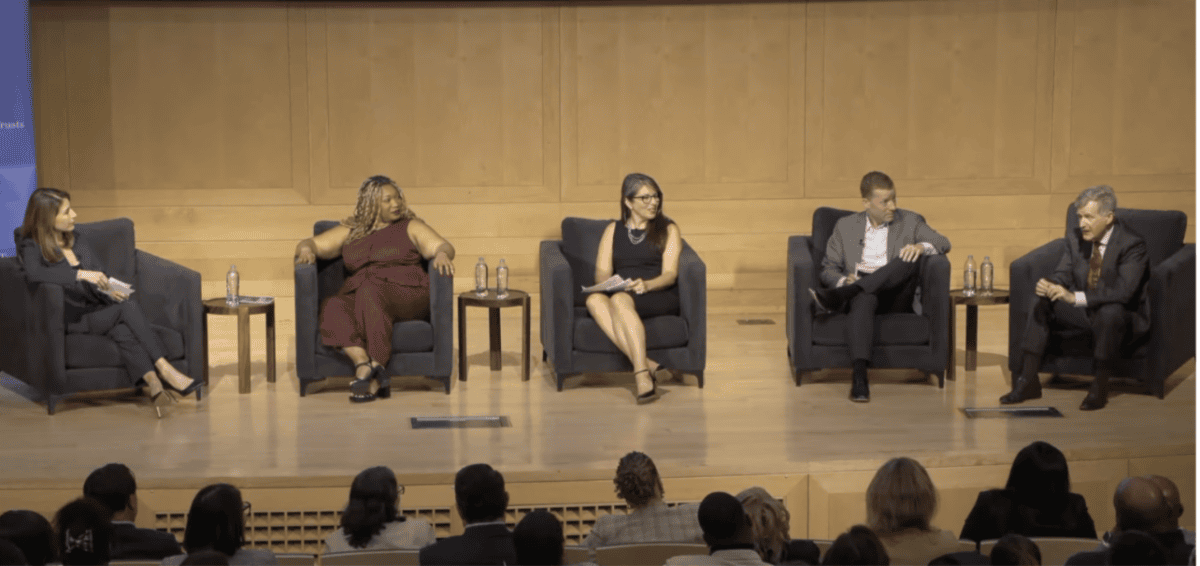
As Philadelphia and cities across the country emerge from the disruptions of the pandemic, a central question is taking shape: what explains the recent decline in gun violence, and what will it take to sustain it?
The Pew Charitable Trusts hosted a convening on April 28 at the National Constitution Center to mark the release of its 2026 State of the City report. During a panel on post-pandemic recovery and urban policy, experts pointed to a clear but often overlooked reality. The drop in violence did not come from any single strategy or institution. It reflected a convergence of factors, including public investment, community-based efforts, and shifts in how cities responded to a crisis.
Moderated by investigative journalist Claudia Vargas, the panel brought together national urban policy experts, including Mallory Baches of the Congress for the New Urbanism; Nina Idemudia of the Center for Neighborhood Technology; Rip Rapson of the Kresge Foundation; and Patrick Sharkey of Princeton University.
Philadelphia’s Collaborative Civic Response
In Philadelphia, that reality has been visible in real time. As violence surged during the pandemic, the government alone did not have the capacity to respond at the scale required. That gap created space for broader civic engagement. Organizations, community leaders, health systems, businesses, and philanthropy stepped in alongside public agencies, contributing to a more collaborative and sustained response.
The Civic Coalition to Save Lives emerged within that context, helping to align sectors around a shared understanding that focused, evidence-based intervention for those at the highest risk is a core component of public safety. Its work has reinforced the idea that reducing violence requires more than enforcement. It depends on sustained investment in intervention strategies, as well as the people, neighborhoods, and systems that can reach those most at risk.
The Importance of Sustained Investment
Panelists emphasized that the federal government’s American Rescue Plan played a stabilizing role, allowing cities to expand programming, support community organizations, and address immediate needs. But they also warned that these gains are fragile. Researchers pointed to underlying challenges that continue to shape violence, including economic instability, concentrated poverty, and the widespread availability of guns. Addressing those factors requires long-term commitment, not short-term funding cycles.
Alignment and Long-Term Commitment
The conversation also underscored the importance of coordination. Public safety outcomes improve when multiple sectors operate in alignment, combining data, resources, and on-the-ground insight. Rapson called for a shift toward what he described as distributed civic leadership.
“The idea is that you find folks from civil society, neighborhood society, philanthropic, private, public, [to] work collectively, to problem [solve], rather than start expecting one source of solution always be in place,” he said.
There is growing recognition that the conditions that led to the decline in violence must be maintained and strengthened. Community-based programs, workforce pathways, and neighborhood-level interventions were described as essential components of a broader public safety strategy.
Sustaining the Progress
The message from the panel was consistent with what Philadelphia has experienced. Progress is possible, but it is not self-sustaining. It depends on continued focus, investment, and collaboration across sectors.
For Philadelphia, the recent decline in violence marks an important milestone. The challenge now is ensuring that the conditions behind that progress remain in place.
Pew Report Confirms Historic Drop in Violence, Need to Fight Deep Poverty, Domestic Abuse
The latest Pew Philadelphia 2026 State of the City report brings mixed news for the City. The acute crisis phase of both gun violence and overdoses appears to be easing, but underlying economic stressors and domestic violence remain serious ongoing concerns.
- Homicides hit a 59-year low — 222 in 2025, down 17.5%
- Shootings fell below 1,000 for the first time in 20+ years
- Overdose deaths dropped to ~1,000 — but 1 in 3 Philadelphians know someone who has died from one
- Domestic violence hotline received 4,037 calls in 2025, concentrated in north and west Philly
- Poverty dipped below 20% — but 300,000+ residents still live on ≤$33K/year
- Unemployment rose to 5.1%, its highest since 2021
- Educational attainment has stalled since the pandemic — a long-term risk factor for community safety
The full Pew Philadelphia 2026: State of the City report is available at pew.org.
New Partnership Highlights the Power of Data and Community Intervention
Reducing gun violence requires more than urgency. It requires precision.
A new collaboration between Every Murder Is Real (EMIR) and the Philadelphia District Attorney’s Office (DAO) Data CoLab highlights how data and trusted community partnerships can work together to strengthen violence prevention in Philadelphia.
EMIR (a Coalition grantee) is a Philadelphia-based frontline intervention organization founded by Victoria Greene after the loss of her son, Emir. Today, the organization provides crisis response, victim services, trauma-informed care, case management, relocation support, and community healing initiatives for individuals and families impacted by violence.
The DAO Data CoLab is an initiative of the Philadelphia District Attorney’s Office focused on using research, data analysis, and partnerships to better understand violence, improve decision-making, and connect communities to effective resources. Through this collaboration, EMIR and the Data CoLab are developing community asset maps and expanding resource guides that help residents access support already present in their neighborhoods.

Asset mapping focuses on “what already works” and how existing strengths can be leveraged to create positive change. EMIR’s mission reflects that same spirit, transforming “loss into leadership” through advocacy, healing, and community engagement.
That approach aligns closely with the work of the Civic Coalition to Save Lives, which champions evidence-based intervention strategies proven to reduce gun violence. Data is a critical part of that model, helping ensure support reaches the right people at the right time, improving coordination, and guiding resources where they can have the greatest impact.
The Coalition helped advance this strategy through the launch of the Gun Violence Intervention Coordination Center, which supports the efforts of the Philadelphia Office of Public Safety’s data-informed coordination across agencies and community partners. The collaboration reinforces Mayor Cherelle Parker’s prevention-intervention-enforcement (PIE) approach to community safety connecting credibility of seasoned intervention providers with actionable data, to help Philadelphia build safer neighborhoods and save lives.
Photo credit: Philadelphia District of Attorney’s Office
Culminating Reception Honors Strategic Plan Participants
Philadelphia Police Department completes first comprehensive strategic plan through broad, citywide effort
City, community, and law enforcement leaders gathered on Tuesday, April 21 at the Philadelphia Public Services Building to mark a major milestone for the Philadelphia Police Department: the completion of its first comprehensive strategic plan developed through a broad, collaborative process.
The culminating reception recognized the contributions of participants who helped shape the Philadelphia Police Department’s Five-Year Strategic Plan as members of the Leadership Team, Steering Committee, and Advisory Groups. The effort brought together department employees, city leaders, and community members to inform a forward-looking roadmap grounded in shared responsibility and accountability.

Hosted at 400 North Broad Street, the event featured a brief program, where speakers reflected on the scale of the collaboration and the importance of sustaining engagement beyond the plan’s release.
Philadelphia Police Commissioner Kevin Bethel emphasized that the plan reflects a shift in how the department approaches its work and its relationship with the community.
“This is our plan,” Bethel said. “If we do this right, it will set us up for the future. This is not something that sits on a shelf. Stay with us, keep pushing us, and hold us accountable, because we cannot do this alone.”
The strategic plan moves beyond a traditional focus on crime reduction to address the systems that support effective policing, including officer wellness, community partnership, and the role of technology. The process itself of bringing diverse voices into the room was central to its development.
The Plan was developed with the financial support of and collaboration with the Philadelphia Police Foundation and the Civic Coalition to Save Lives. For the Coalition, the approach reflects a core principle: durable progress depends on coordinated effort, shared ownership, and continued discipline across sectors. As implementation begins, the success of the plan will depend on the same level of engagement that shaped it.
The plan is expected to be publicly released at a press conference in May.
ICYMI
News Roundup: Spotlight on Intervention
Each month, we feature news stories from Philadelphia and beyond that highlight the power of intervention—showcasing programs, research, and community efforts working to prevent violence, support those at highest risk, and build safer neighborhoods through proven, people-centered strategies


Join the Movement
Gun violence is down. Let’s keep it that way.
- Get involved → Visit our Engagement page
- Find resources → Explore tools & updates
- Request a briefing → Bring the Coalition to your organization